Menu

Novità
Numero di articolo: 5208200002
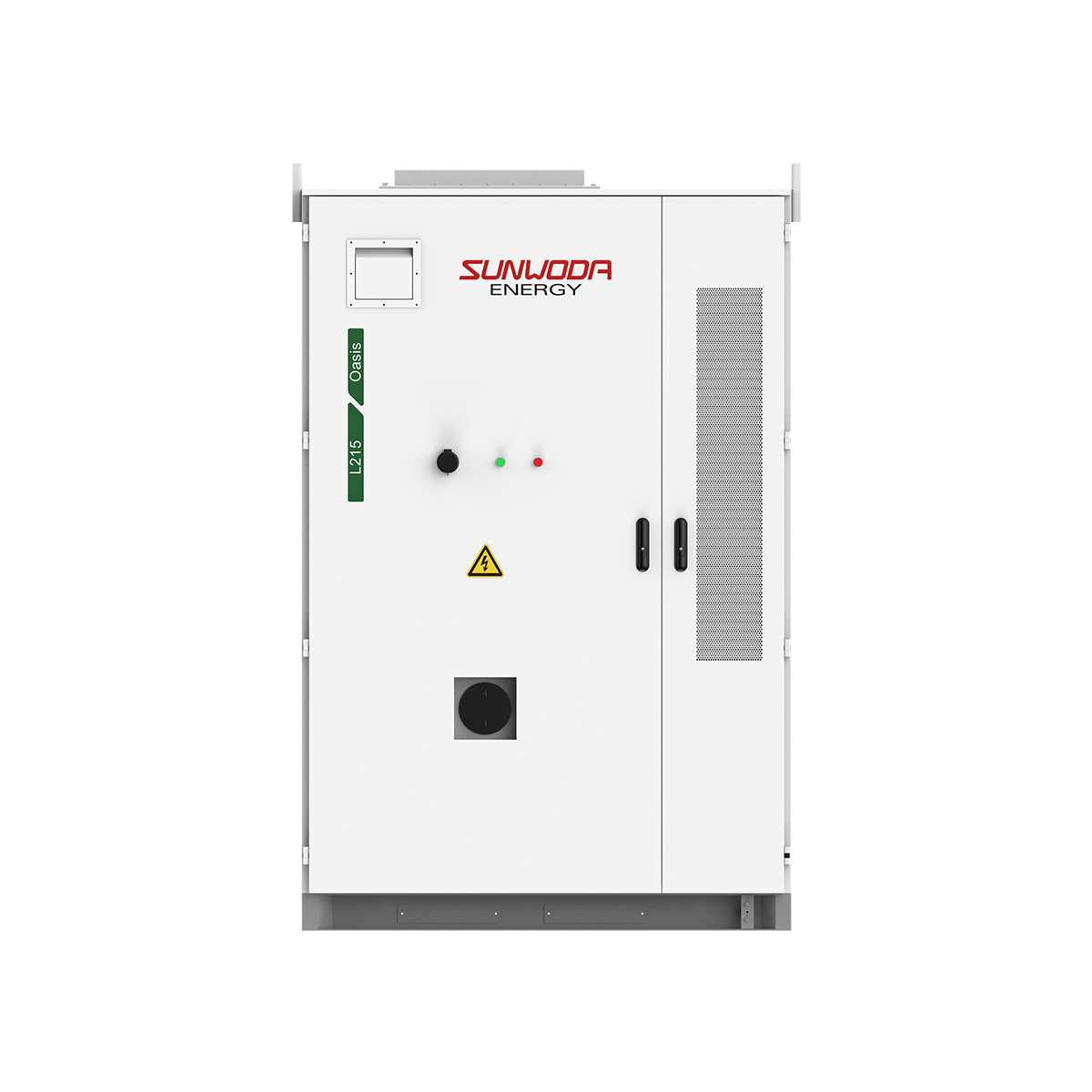
Sunwoda Oasis L215
Battery storage system
5 Pezzo disponibile
Merkmale
Larghezza [mm]
1,570
Altezza [mm]
2,380
Peso [kg]
3
Energia [kWh]
215
Profondità massima di scarica [%]
100
Tipo di batteria
Litio
Tensione nominale [V]
768
Batt-Reg.-Nr. DE
76,918,096
N. di registrazione RAEE DE
74377197
Descrizione
Compatible inverters must be checked according to the release list. The manufacturer's specifications regarding the installation site and setup must be observed. This applies in particular to the storage and assembly of the storage modules. Suitable crimping tools for the connection plugs must be available (see manual).
Sunwoda Oasis L215 is a liquid-cooled C&I battery cabinet based on LFP technology with 215 kWh nominal energy for grid-tied and hybrid-coupled storage solutions. The system operates at a high-voltage DC level (nominal voltage 768 V, voltage range 624–876 V) and supports high charge/discharge rates up to 1C for peak shaving, load peak capping, and frequency/voltage regulation. The outdoor cabinet (IP55) is designed for industrial, commercial, and utility projects as well as microgrid scenarios and can be integrated with external PCS/EMS. Liquid cooling (water/glycol) maintains stable cell temperatures during operation from −30 °C to +55 °C.
 Warranty & SafetyThe safety concept combines LFP chemistry with multi-level monitoring and integrated protection functions within the cabinet design. Cell and pack monitoring via BMS, temperature and smoke detection, as well as the detection of flammable gases, support early event recognition. An integrated fire suppression and exhaust air concept, along with pressure-relief components, are designed for operation in demanding C&I environments. A standard warranty of 5 years is provided for the product; an extension is optionally available depending on the project and contractual framework.
Safety functions at a glance- Multi-channel sensors (temperature/smoke/gas) for condition monitoring and event detection.
- Integrated fire suppression and exhaust air system for outdoor cabinet operation.
- Protection concept with pressure relief and defined gas discharge to minimize risks in case of a fault.
 ConnectivityStandard communication interfaces are available for system integration to link the battery, PCS, and higher-level energy management. CAN and RS485 support internal/local communication, while Ethernet enables connection to control or cloud infrastructures. The solution is designed for external EMS/PCS integration and supports monitoring, status history, and fault recording for commissioning and operational management. Digital inputs and outputs allow integration into protection, release, and signaling logic at the plant level.
Interfaces for EMS/PCS and Monitoring- CAN/RS485/Ethernet for BMS communication, control system connection, and remote operation.
- DI/DO for status messages, interlocks, and external release logic in the control cabinet environment.
- Support for remote monitoring and event logging for operational optimization.
 Installation ConceptThe Oasis L215 is designed as an all-in-one outdoor cabinet with pre-configured battery packs, control box, and liquid cooling system, intended for rapid setup in project business. The footprint can be used efficiently through back-to-back or left/right arrangements. With an IP55 protection rating, an operating range of −30 °C to +55 °C, and operation up to 2000 m, the system is suitable for diverse locations. For mechanical planning, dimensions of approx. 1570 × 1350 × 2380 mm (W×D×H) and a weight of around 2385 kg must be considered.
Planning-relevant installation parameters- Outdoor cabinet concept (IP55) for robust installation in C&I environments.
- Liquid cooling with water/glycol for thermal stability and uniform power output.
- Installation layout with back-to-back option for space optimization in container or open-field designs.
 SustainabilityAs an LFP storage solution, the Oasis L215 supports long-term operating strategies for C&I applications, particularly with frequent cycles due to peak shaving and PV self-consumption optimization. Liquid cooling helps reduce thermal stress and can limit aging through more uniform cell temperatures. For the life cycle, defined operating windows (temperature/humidity without condensation) are also relevant to stabilize efficiency and availability in the field. In project planning, this supports a maintenance- and operation-oriented design for energy efficiency management, load shifting, and microgrid operation.
Download